Auf einen Augen-Blick
February 11, 2012
‘Auf einen Augen-Blick’ is an animated video piece using sequences of hand corrupted jpg files. If I was a bit smarter i could probably have written a script that batch processed multiple files but I found that there is something important in the laborious process of doing each frame by hand – it introduces some organic element into what should be an efficient process…I like the contradiction of using digital media in such a manual way…especially when the content is all about degradation and corruption of the media itself.
Sunseastar ‘Saccades’
September 28, 2010
Video from the Sunseastar album ‘Fjaerland’
Orgonite melt
November 9, 2009
Geoff Leigh has uploaded some of his video experiments with ice formed under the influence of orgonite (with a soundtrack of some music work we did earlier this year). Orgonite, a dubious by-product of the Willhelm Reich school of pseudo-science, is an agglomerate of left handed metal swarf and acrylic resin said to have mysterious and mystical properties…
Links:
Musical roads of the world.
January 19, 2009
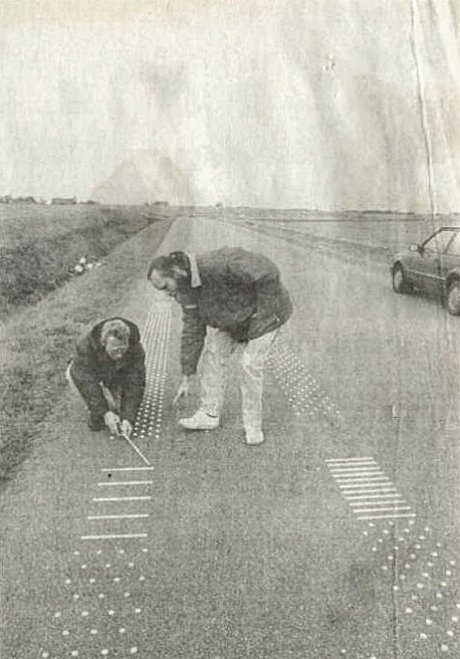
Steen Krarup Jensen and Jakob Freud-Magnus building the Asphaltophone
Earworms, Surgery and Musical hallucinations
September 18, 2008
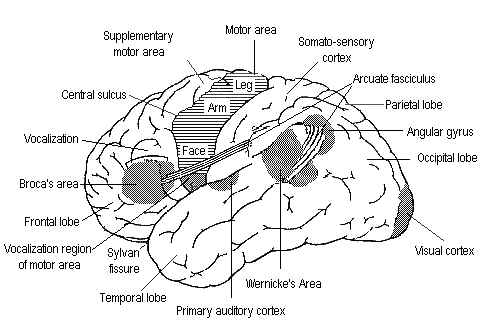
Earworms:The Cognitive Itch Theory
Noise England: London; ” Unsuitable for human habitation”
August 1, 2008
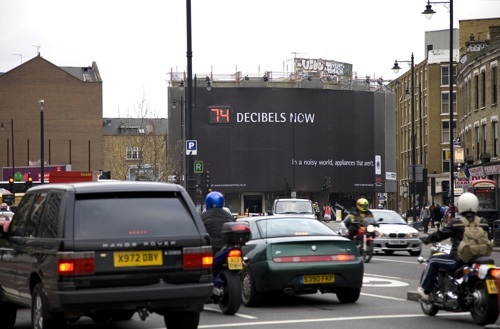
Image: Street advert in Hoxton, London, displaying real-time decibel level. March 2008.
“Let us cross a great modern capital with our ears more alert than our eyes, and we will get enjoyment from distinguishing the eddying of water, air and gas in metal pipes, the grumbling of noises that breathe and pulse with indisputable animality, the palpitation of valves, the coming and going of pistons, the howl of mechanical saws, the jolting of a tram on its rails, the cracking of whips, the flapping of curtains and flags. We enjoy creating mental orchestrations of the crashing down of metal shop blinds, slamming doors, the hubbub and shuffling of crowds, the variety of din, from stations, railways, iron foundries, spinning wheels, printing works, electric power stations and underground railways.”
Luigi Russolo excerpt from “L’arte dei Rumori” 1913
Russolo’s eulogy to the sonic city was inspired by the urban clamour of turn of the century Milan. “L’arte dei Rumori” betrays a fascination with novelty of noise, the signature of modernity and the promise of the future in the form of the industrial city. Russolo argued that music has reached a point where it can longer excite when pitted against the real world sonic complexity of new metropolis. In turn, this statement led to the formation of a new type of music based on machine inspired atonality and stochastic composition.
Noise Mapping England Pt2
May 19, 2008
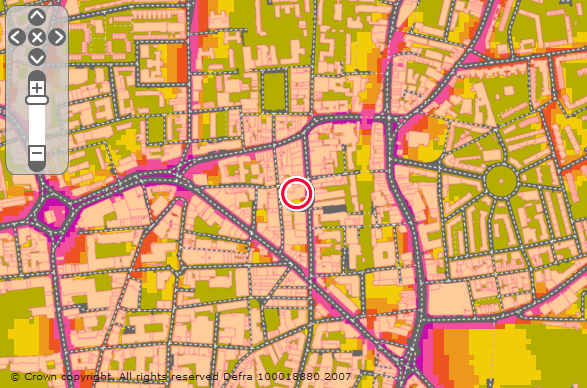
The much anticipated Noise Maps version 2 was released by our favorite government agency, DEFRA, last week. This version includes a noise source filter (road, rail, industry and air) – which ‘kind of’ works – and day and night switch. The maps spread beyond London to ‘agglomerations’ of over 250,000 people…everyone else will have to wait until 2012 for round two – or make do with pdf of ‘major roads’ and airports.
Making Music on Ubuntu Linux
May 9, 2008

Ubuntu is the Linux distro ‘for human beings’. This means it’s easy to install, maintain and use by ‘real people’ for everyday tasks. It’s available free and supported on an open source license by a global community of developers (and commercially supported by Canonical Ubuntu’s founders). In practice it’s a joy to use – lightweight, responsive with an uncluttered GUI, it genuinely works ‘out of the box’ on even the most obscure hardware (almost), and, importantly, doesn’t further line the pockets of Bill Gates or Steve Jobs. I’ve been using Ubuntu for about a year with the aim of eventually liberating myself from the tyranny of Windows and OSX – yet however good the OS is, it’s only as useful as the software that runs on it. I would like to see a free, open-source professional set of music tools running on a freeopen-source professional platform; The latest version of Ubuntu (8.04 Long Term Support) has just been released so it’s a good time to review the feasibility of music making with open source only software. Most of the applications detailed here are bundled with Ubuntu Studio a ‘multimedia’ dreivative of Ubuntu – or can be installed separately via Synaptic Package Manager.
Onomatopoeic proposal.
March 26, 2008

Onomatopoeia is a word that imitates the sound it describes e.g. ‘Crash’ , ‘Miaow’ etc. and as such are possibly the origins of spoken languages being the simplest form of communication – imitating an object to communicate meaning ( for instance in Chinese ‘Mao’ 猫 has become the word for a cat, based originally on it’s sound). Onomatopoeic words are some of the most recent additions to languages, incorporating direct imitations of the post industrial world, ‘Beep’, ‘Zap’, ‘squeak’…occasionally becoming nouns; ‘ratchet’, ‘Crank’ etc. Curiously onomatopoeic words vary considerably across the globe; different cultures seem to hear differently. Languages themselves once established obviously restrict and distort the ability to form ‘pure’ onomatopoeic words but cultural variations also play a part – in the same way that the perception of musical tone and harmony vary across cultures. As an experiment i propose a WIKI Onomatopoeia library which would allow anyone to describe their literal interpretation of sound – not the accepted cultural/linguistic form (e.g. ‘woof’ for a dog) but what the individual hears. This would form a living recording of audio interpretation and the cultural variations and distortions that occur in different regions.
Tintin and Infrasound
January 15, 2008

Curious blog synergy: An article based on the Stalker ‘Early warning/Acoustic radar‘ post from our Portuguese comrades at Anauel, involves acoustic radar, Tintin and, unknown to them, relates back to the new Stalker post on Infrasound. Herge’s drawing of the German sound weapon is actually taken from a photograph of the ‘Luftkanone’ at the Elbe river in 1945:
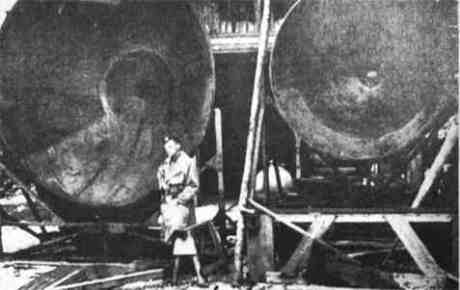
The book illustrated is Leslie E Simon’s real and much sought after post war research into German WW2 experimental weaponry “German research in WW2”
Full article (in Portuguese) is here: http://anauel.blogspot.com/2008/01/oh-capito-isso-extraordinrio.html
A Short History of Sound Weapons Pt2: Infrasound
January 14, 2008
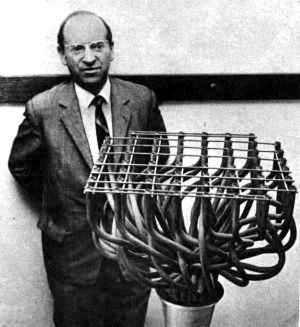
(image: Vladimir Gavreau)
Infrasound is low frequency audio beneath the human range of hearing. Infrasound constantly surrounds us, generated naturally; wind, waves, earthquakes and by man; building activity, traffic, air conditioners and so-on. Low frequency sound is used by marine mammals to communicate over vast distances and by birds to determine migration patterns.
At higher volumes infrasound of around 7-20hz can directly affect the human central nervous system causing disorientation, anxiety, panic, bowel spasms, nausea, vomiting and eventually unconsciousness (supposedly 7-8hz is the most effective being the same frequency as the average brain alpha wave). The effect is unintentionally (or not?) generated by the extreme low frequencies in church pipe organ music, instilling religous feelings and causing sensations of “extreme sense sorrow, coldness, anxiety, and even shivers down the spine.”(1) in the unsuspecting congregation. Low frequency sound generated naturally or by building work and traffic is said to be the cause of reported apparitions and hauntings (2) – blamed on the ghostly 19hz frequency which matches the resonating frequency of the human eyeball:
Frequency & effects:
7 Hz: Supposedly the most dangerous frequency corresponding with the median alpha-rhythm frequencies of the brain. It has also been alleged that this is the resonant frequency of the body’s organs therefore organ rupture and even death can occur at prolonged exposure.
1-10hz: “Intellectual activity is first inhibited, blocked, and then destroyed. As the amplitude is increased, several disconcerting responses have been noted. These responses begin a complete neurological interference. The action of the medulla is physiologically blocked, its autonomic functions cease.” (Gavreau )
43-73hz: ” lack of visual acuity, IQ scores fall to 77% of normal, distortion of spatial orientation, poor muscular coordination, loss of equilibrium, slurred speech, and blackout”.(Gavreau )
50-100hz: “intolerable sensations in the chest and thoracic region can be produced – even with the ears protected. Other physiological changes that can occur include chest all vibration and some respiratory rhythm changes in human subjects, together with hypopharyngeal fullness (gagging). The frequency range between 50 and 100 Hz also produces mild nausea and giddiness at levels of 150 – 155 dB, at which point subjective tolerance is reached. At 150 to 155 dB (0.63 to 1.1 kPA), respiration-related effects include substernal discomfort, coughing, severe substernal pressure, choking respiration, and hypopharyngeal discomfort.” (Davies)
100hz – At this level, a person experiences irritation, “mild nausea, giddiness, skin flushing, and body tingling.” Following this, a person undergoes “vertigo, anxiety, extreme fatigue, throat pressure, and respiratory dysfunction.”(Gavreau )
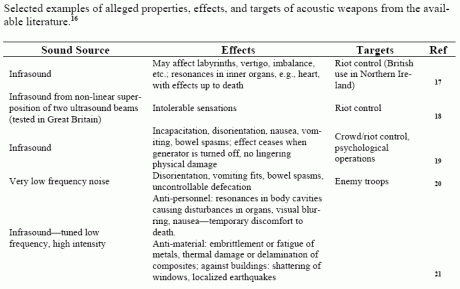
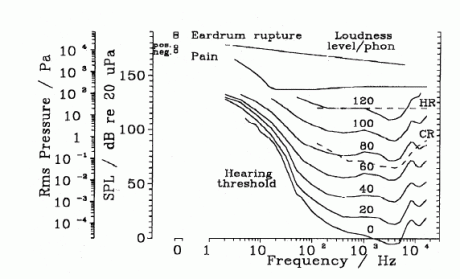
(images: tables from “Acoustic Weapons—A Prospective Assessment: Sources, Propagation, and Effects of Strong Sound” Jürgen Altmann)
The first documented attempt to reproduce the infrasound effects was by the much mythologised Russian/French physicist Vladimir Gavreau in 1957. Gavreau became interested in infrasound when he was asked to cure a case of ‘Sick Building Syndrome’; Staff at a research plant in Marseilles were mysteriously falling ill. Chemical or pathogen poisoning was suspected but Gavreau eventually traced the origin of the illnesses to an air conditioning units rotating fans that were generating low frequency sound waves. Gavreau began to experiment with low frequency acoustics with the intention of creating a viable audio weapon for the French military. Several prototype designs of various sizes were produced christened ‘canon sonique’ consisting of piston driven tubes and smaller compressed air horns and whistles. Gavreau and his team tested the instruments on themselves at the Marseilles plant with unexpected success as apparently one of the team died instantly “his internal organs… mashed into an amorphous jelly by the vibrations”:
“Luckily, we were able to turn it off quickly. All of us were sick for hours. Everything in us was vibrating: stomach, heart, lungs. All the people in the other laboratories were sick too. They were very angry with us. “
Early Warning: Acoustic Radar
January 10, 2008
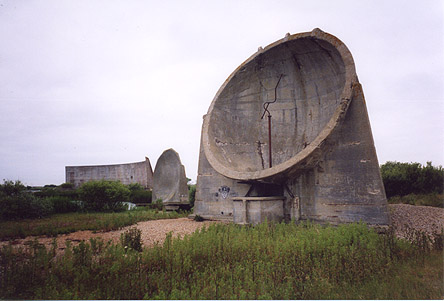
Image: Sound Mirrors near Dungness, Kent, UK
Scattered around the South East coast of England are these concrete objects. They are Acoustic Mirrors, built from 1916 to the mid 1930’s as an acoustic early warning system . The mirrors were simply large ‘acoustic ears’ used to locate approaching enemy aeroplanes and Zeppelins by amplifying and pinpointing engine sound – they had a range of around fifteen miles which gave a few minutes extra warning over visual location . The parabolic mirrors reflected and focussed the sound into one spot which was picked up by the listener through a rubber tube attached to the ears – a great example of the practical application of British exentricity. The mirrors eventually became obsolete with the development of faster aircraft and killed off entirely with the invention of Radar.
Mobile versions of the sound mirrors were still in use by Germany, Briatain and the USA during the Second World War as crude anti aricraft warning devices:
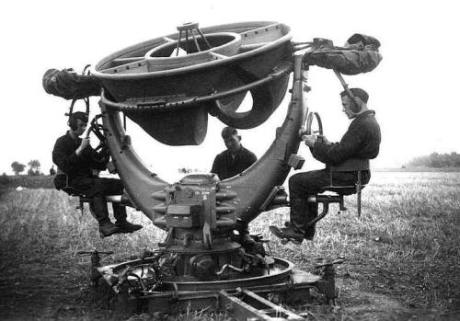
Image: German Acoustic Early Warning device 1940s

Image: British Acoustic Early Warning device 1940s
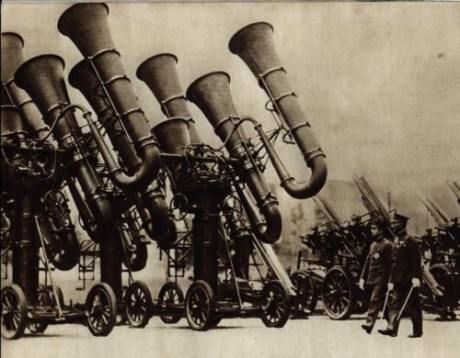
Image: Japanaese Mobile Acoustic Horns 1930s
Link:
Sounds From Memory #3: Riot.
December 12, 2007
The intention of these series of posts is to document sounds that have remained in memory. Not sounds that are particularly pleasant or trigger ‘Proustian Resonance’ but unique sounds that once heard are never forgotten (therefore impossible to reproduce or record). If i get enough – and please add your own – i’ll organise them into a top ten ‘mnemaudio’ chart.
 Miles was the first casualty, and, I always maintain, the inspiration for the violence that took place at the Trafalgar Square Anti-Poll Tax protest in 1989. During what was an admittedly tense but peaceful sit down protest in front of Downing Street, Miles charged at the Police brandishing a metal pole. He was immediately floored, struck on the head by a brick thrown from the police lines*. Seconds later the police panicked and sent mounted riot squads charging into the unarmed protesters, this event ignited a day of fierce fighting in the centre of London. For six hours the police held protesters in the square: The sound that fixed in my memory is the combined roar of bottles and bricks being thrown, burning buildings, screams, police sirens, helicopters, horses, whistles and ambulances which, after six hours, merged into one high pitched continuous distorted scream. This noise stayed with me for weeks, day and night -a kind of hysterical tinnitus.

*I dragged miles to an ambulance which took him to hospital. A few hours later he discharged himself, concussed, dripping blood from a head wound he returned to the battle pressing home his assault on the forces of ‘law and order’.
…
A Short History of Audio Weapons
December 10, 2007
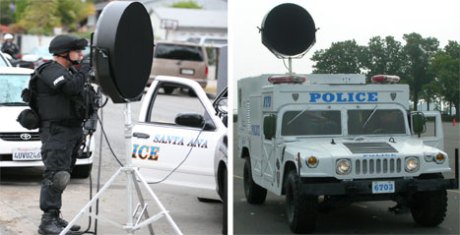
Part 1: ‘Long Range Audio Device’
Baghdad, Fallujah, New York, Tbilisi
Designed and built by the American technology Corporation in 2005 and originally designed as a ship to ship hailing device to protect US naval shipping, LRAD is now used by the Illegal American occupation forces in Iraq as an assault weapon, by the US government on their own people as part of their ‘non lethal’ arsenal for crowd control and more recently by the (US sponsored) Georgian state to repress internal dissent.
LRAD emits a high pitched warning tone “similar to a fire alarm” or a series of ‘verbal challenges’ (translatable through an inbuilt ‘phrase-olator’ or online via TCP/IP connection “immediately retrieve thousands of messages recorded by the Defense Language Institute”) over a maximum effective land distance of 300metres at a volume of120-150db(1.). Used at medium range and beyond the manufactures specified duration the device is capable of delivering sounds well beyond the human pain theshold (120 – 140 dB); at a distance of 90m the LRAD will cause intense pain and permanent hearing loss(2.)
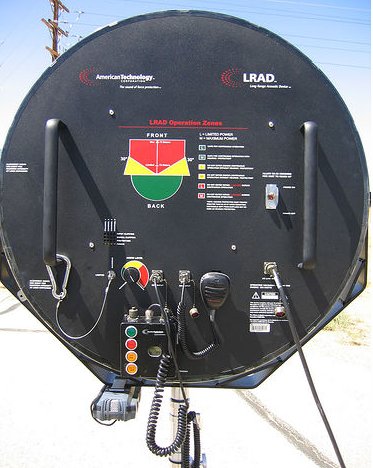
(image: back of the LRAD)
The LRAD is basically a series of in-phase speakers (not a infra-sound generator as commonly supposed). The phasing of the sound (combined amplitude giving louder sound) gives the device the ability to project high frequency sounds over a long distance at high volume.To focus the sound the LRAD uses a set of out of phase speakers around the perimeter of the device to phase-cancel the sound giving a directional arc of 30 degrees. Fifteen degrees outside the beam, the volume drops about 20 dB which although still loud means that the operator can focus the LRAD to a specific target without being themselves affected.
specifications:
- Range: 300 meters over land or 500 meters (1640 feet) over water.
- Beam width: About 30 degrees
- Size: 33-inch diameter by 5-inch thickness
- Weight: 45 lbs
- Input: Microphone, laptop, MP3 player, CD player, ‘Phraselator’ translation device
- Maximum Volume: 120 dB at 1 meter in normal operation, 146 dB sustained or 151 dB burst at 1 meter with override
Sources
(1.) The American Technology Corporation (ATCO)
(2.)Carl Gruenler, (former) vice president of military and government operations for American Technology Corp
Sounds from memory #2: Human Vs Car
November 27, 2007
Location: Outside the Odeon Cinema, Oxford UK.
Walking out of a cinema in that familiar post film haze, the man next to me stepped out into the street and was hit by a taxi. The sound was a short but very loud bang followed by the smashing of glass (was he carrying bottles or was it the car headlights shattering on impact?). I was surprised by the solidity of the bang considering the softness of a human body against a metal surface and confused, the man had disappeared right in front of me. Where had he gone? was he under the car or had he bounced off the vehicle bonnet into the street? The taxi had come to an immediate halt some distance away (film sound effect of screaming tires) the driver gripping the wheel with both hands, staring straight ahead.
Sounds from memory #1: The MRI Scan
November 19, 2007
The intention of these series of posts is to document sounds that have remained in memory. Not sounds that are particularly pleasant or trigger ‘Proustian Resonance’ but unique sounds that once heard are never forgotten (therefore impossible to reproduce or record). If i get enough – and please add your own – i’ll organise them into a top ten ‘mnemaudio’ chart.
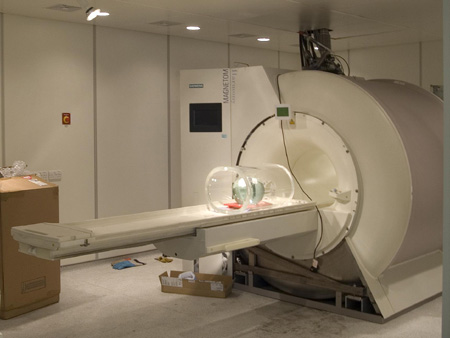
The MRI Scan
Andy (Wilson) and I regularly cite the MRI scanning machine as a prime influence on sunseastar’s music having both been fortunate enough to witness the machines unique timbre up close (…are sunseastar the only group where all members have had brain scan?). The Magnetic Resonance Image Scanner is a medical device used to generate images of the soft tissues of the brain for the diagnosis of illnesses. The unfortunate patient is strapped to a horizontal bed which is introduced slowly into the small cavity of a large metal wheel – a very claustrophobic and alarming experience – you are allowed a view of your feet via a mirror near your head but apart from that you can see nothing. The staff switch the machine on and leave the room with unsettling haste.
The sounds come in a series of about six sequences ( different angles of the scanning device through the head?) of a few minutes each over a total of thirty minutes (in my case). The noise is very impressive due to it’s volume and unexpectedness – It’s very loud and very close and, because you are strapped in to a small space, there’s no way to get away from it:
“Due to the construction of MRI scanners, they are potentially unpleasant to lie in. The part of the body being imaged needs to lie at the center of the magnet (which is often a long, narrow tube). Because scan times may be long (perhaps one hour), people with even mild claustrophobia are often unable to tolerate an MRI scan without management.”
The noise can be described as a high volume grating mechanical ‘GRRRR’ of regular but varying tone on each pass. If this sound came from any other machine it would be an indication that it was about to fail with catastrophic and lethal effect – which is quite alarming considering it is inches from your unprotected face:
“Acoustic noise: Loud noises and vibrations are produced by forces resulting from rapidly switched magnetic gradients interacting with the main magnetic field, in turn causing minute expansions and contractions of the coil itself. This is most marked with high-field machines and rapid-imaging techniques in which sound intensity can reach 130 dB – equivalent to a jet engine at take-off.”
 stalker